Showing posts with label Animaniacs modelsheets. Show all posts

Friday, October 3, 2014

You are the Client!

Does this ever happen to you? You are working on your own project with a deadline you hope to reach when suddenly, an outside job opportunity comes along. Now you have to drop everything again and work on this other project, which is paying for your time and expertise.

Recently, a short commercial has driven up to my front door and needs my animation help. Its a small car commercial spot which involves two important things. 1) Design a cartoon version of an actual car dealer and 2) Animate the entire :30 spot in October.(ha!)

First, when starting a job you need to find out all the information you can about what they want, when is their deadline and how much will they pay. Once you have some of this info, you need to put together a bid or an estimate of how much time and labor it will take you to accomplish the project. I'm skipping over all this stuff since this is not a business blog and going right for the animation process stuffing.

I will mention that when I bid on this job, it was a totally different idea when my bid was approved. Luckily, even though its was a different idea altogether, the new idea was a lot simplier than the first, but does involve some character designs and rough storyboarding.

Most large studios or ad agencies have a storyboarded concept and character designs already to send off to the chosen animation studio. Smaller places don't.

The client sent me a photo of a real Car Deal guy, who I'm suppose to create a cartoon version of and so, experience has taught me to draw a bunch of rough ideas, number them and let the client decide which one they would like me to do more work on.

And now, You are the client!  
Your Deadline is Friday:10/10/14

Here are 10 possible cartoon characters, perhaps the next Homer Simpson! Which Cartoon guy do you like and if you can tell why? 
The real Client already made their choice, but I want to hear from you!!! You may send me a comment and let me know which number you like and I won't mention your name.  
Vote Early, Vote Often!  Submit by 10/10/14

Thursday, April 24, 2014

Lip Sync Animation


Lip sync animation was always a mysterious process for me when I was learning how to do it and my only guide was this famous Preston Blair book. This book contains a section showing the generic cartoon mouth shapes and the sounds that matched. Several sounds could share the same mouth shape, like a closed mouth could be used during an M, B or P sound.

Later, I got to read a sound track on an old school Steinbeck flat bed editor. This oven sized editing machine could play sound and picture together and was used to cut something called film, centuries ago. My task was to sit down on this beast, scroll thru the sound very slowly and breakdown the sounds unto the exposure sheet. Today, I do the same task using ToonBoom Animate Pro or Storyboard.

The more you do, the better you get and I discovered that you don't want your mouth position changing every frame. Its ok to have one position overlap a frame, because it will look more natural. It will not draw your attention to the speed of the mouth if its on two's, unless you have a character who is very fast and you want to show that in his speech pattern as well.

Breaking down the soundtrack is a process which is the same for both 2D and 3D animation and it will take sometime to do. Sometimes, I would have play as sound forward and backward to find where a the word started or  ended. A weird thing I picked up while track reading was that the word "Yes", when played backwards will sound like "Say". And its better to read dialogue instead of having it with sound effects and music on the same track.

So, if I had a recorded line of a character's voice saying, "I will go..." I would listen to the take a few times and get an idea behind the performance. Then I would listen to the track very slowly, by scrubbing thru the sound file to see how long each word takes to say in frames.

The word "I" is made up of two sounds, "Ah" and "Ye". Said quickly or slowly, "I" could cover 2 to 6 frames of sound. An exposure sheet is incredibly useful in 2D animation and is necessary in writing down all the dialogue breakdown information. Here is an example of breakdown dialogue on an exposure sheet. Can you understand what is being said phonetically?

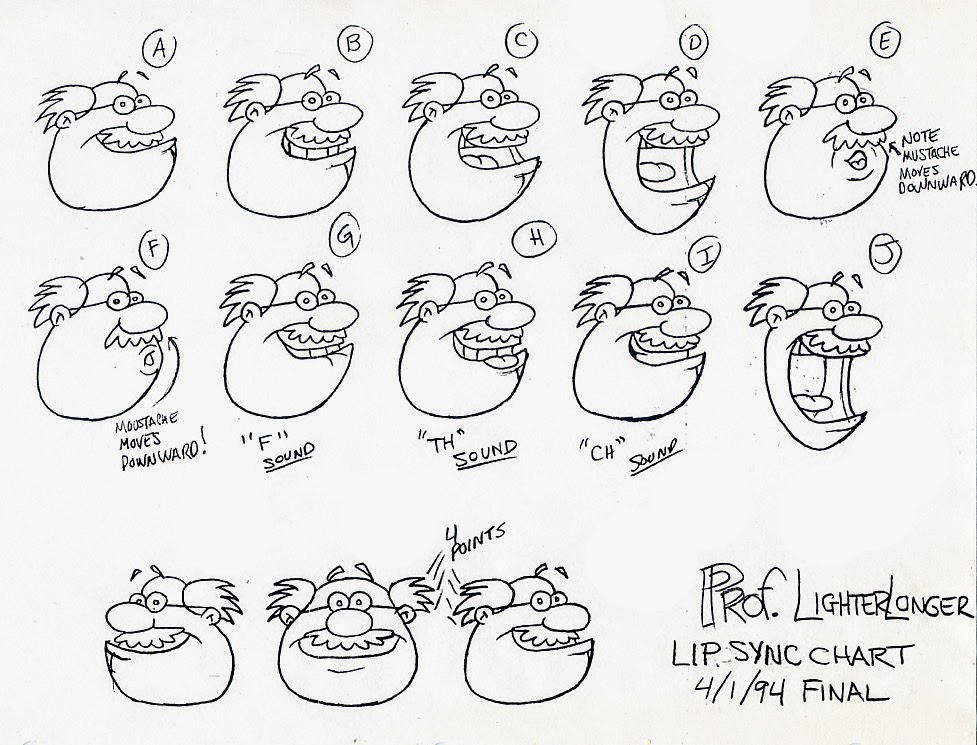
Here's a standard mouth chart used in Animaniacs. Notice how mouth H is similar to mouth C, except for the tongue placement. Also "Y" mouth is an inbetween of mouth B and mouth C, allowing a smoother transition from B to C.  


Here are several Mouth charts for various characters from Animaniacs. These mouth positions were labelled on the X-sheets, so the animators knew what mouth to draw at which frame.

Below is a more snobby type character. Notice the differences in mouth design.


All of the above mouth charts are shown to be from a happy expression, but what if you have a character that goes from happy or sad or mad? I had a character who was a sarcastic bully and so my mouth chart shows happy mouths with angry mouths...

Below is a mouth chart of a friendlier character.
I was recently cleaning out my garage and can across some of my animation past. The above two mouth charts are from a video I designed and directed for the ThinkFirst Foundation. It was a short video teaching kids about spinal safety. The script was written by Jim Hardison and produced the video through his company called Image Dynamics in Chicago. I was hired to direct the animation. I found a production notebook full of modelsheets, color info, props and other things which brought back a lot of memories, good and bad.

If you learned something new, click on the ad to the right and the ad below this article, let us know you appreciate animation Thank You!