Showing posts with label animation modelsheets. Show all posts

Thursday, October 9, 2014

You are the client! : Your Choice

Last Week, I invited everyone to pick one of 10 possible rough cartoon character designs. I promised not to mention any names, only which number got the most votes and asked, "Which Cartoon guy do you like and why? " The real Client already made their choice and Thanks for all the emails, Wow!

Ok, here are some of the results...
 Choice #   1  =   42 picks
 Choice #   2  =     5 picks
 Choice #   3  =     0 picks
 Choice #   4  =   28 picks
 Choice #   5  =   37 picks
 Choice #   6  =   13 picks
 Choice #   7  =   94 picks
 Choice #   8  = 138 picks
 Choice #   9  =   17 picks
 Choice # 10  =   12 picks

Thanks again to all 387 of you for sending in your choices. It was great to hear from all of you. One person chose the guy in the middle, under #4, which I completely forgot to give a number.

The real Client chose....


And as soon as I receive my first payment, I will clean up this choice and have a final design for the Client to approve. And so, as they say in France, " Le chèque est dans la poste !"

Thursday, April 24, 2014

Lip Sync Animation


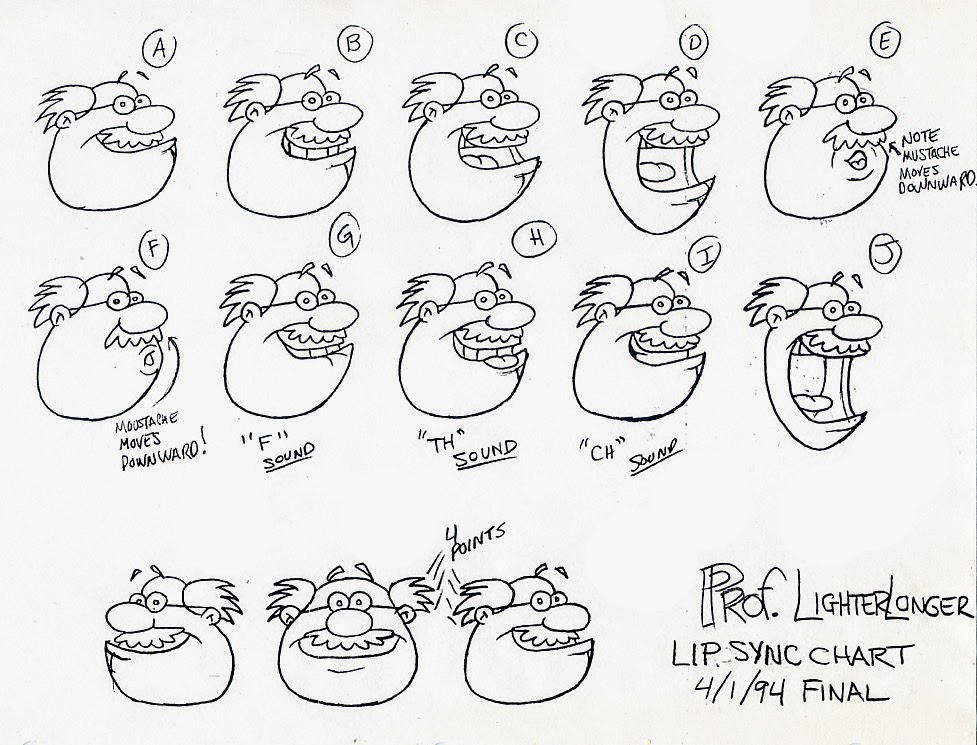
Lip sync animation was always a mysterious process for me when I was learning how to do it and my only guide was this famous Preston Blair book. This book contains a section showing the generic cartoon mouth shapes and the sounds that matched. Several sounds could share the same mouth shape, like a closed mouth could be used during an M, B or P sound.

Later, I got to read a sound track on an old school Steinbeck flat bed editor. This oven sized editing machine could play sound and picture together and was used to cut something called film, centuries ago. My task was to sit down on this beast, scroll thru the sound very slowly and breakdown the sounds unto the exposure sheet. Today, I do the same task using ToonBoom Animate Pro or Storyboard.

The more you do, the better you get and I discovered that you don't want your mouth position changing every frame. Its ok to have one position overlap a frame, because it will look more natural. It will not draw your attention to the speed of the mouth if its on two's, unless you have a character who is very fast and you want to show that in his speech pattern as well.

Breaking down the soundtrack is a process which is the same for both 2D and 3D animation and it will take sometime to do. Sometimes, I would have play as sound forward and backward to find where a the word started or  ended. A weird thing I picked up while track reading was that the word "Yes", when played backwards will sound like "Say". And its better to read dialogue instead of having it with sound effects and music on the same track.

So, if I had a recorded line of a character's voice saying, "I will go..." I would listen to the take a few times and get an idea behind the performance. Then I would listen to the track very slowly, by scrubbing thru the sound file to see how long each word takes to say in frames.

The word "I" is made up of two sounds, "Ah" and "Ye". Said quickly or slowly, "I" could cover 2 to 6 frames of sound. An exposure sheet is incredibly useful in 2D animation and is necessary in writing down all the dialogue breakdown information. Here is an example of breakdown dialogue on an exposure sheet. Can you understand what is being said phonetically?

Here's a standard mouth chart used in Animaniacs. Notice how mouth H is similar to mouth C, except for the tongue placement. Also "Y" mouth is an inbetween of mouth B and mouth C, allowing a smoother transition from B to C.  


Here are several Mouth charts for various characters from Animaniacs. These mouth positions were labelled on the X-sheets, so the animators knew what mouth to draw at which frame.

Below is a more snobby type character. Notice the differences in mouth design.


All of the above mouth charts are shown to be from a happy expression, but what if you have a character that goes from happy or sad or mad? I had a character who was a sarcastic bully and so my mouth chart shows happy mouths with angry mouths...

Below is a mouth chart of a friendlier character.
I was recently cleaning out my garage and can across some of my animation past. The above two mouth charts are from a video I designed and directed for the ThinkFirst Foundation. It was a short video teaching kids about spinal safety. The script was written by Jim Hardison and produced the video through his company called Image Dynamics in Chicago. I was hired to direct the animation. I found a production notebook full of modelsheets, color info, props and other things which brought back a lot of memories, good and bad.

If you learned something new, click on the ad to the right and the ad below this article, let us know you appreciate animation Thank You!

Tuesday, March 25, 2014

About Modelsheets

Back in the days of 2D animation, the modelsheet was a way of showing what the character looked like, so that every animator would know how to draw it "On Model". There are a variety of modelsheets to choose from, everything from Construction, Turnarounds, Body poses, Expressions, Size comparisons, etc. Below are examples of these different formats.

Construction Modelsheets: Show how the character is built from simple shapes and how many heads tall it is as a form of measurement. The famous Fleischer characters below shows this, but also combine facial expressions and slight turnaround poses.
I think the Popeye modelsheet below was done later since his head is measured differently making him only 5 heads tall, rather than the above showing him at 6 1/2 heads tall.
The above images came from Leslie Cabarga's great book " The Fleischer Story". It has a lot of nice artwork from the golden age of animation and tells the history of the Fleischer Studios.

Here's some more Construction modelsheets from Animaniacs, with both front and back views. You can see exactly what shapes are used to build up these characters, making it easier to learn how to draw them correctly.


Do you notice anything missing from the above models of the characters? I'll give you a hint, something is missing from Yakko and Wakko's faces in these designs. Can you guess what it is?

Here's a construction model of one of my favorite characters, Slappy Squirrel.

Construction Modelsheets also should contain written instructions or notes to help draw all the design's details. Here's a side view of SpongeBob Squarepants...


One of my first scenes to animate was from a Slappy Squirrel episode where Slappy was in court and being confronted by a lawyer named Stephen Wolf. In this case, the character was only used in one episode and we were given only one modelsheet. The Lead Animator had to figure out how the character was drawn, so the Assistant Animators would know the correct way how to draw the character . Below is the original turnaround modelsheet of this character.

Here's a construction model and the easiest way to draw it...
There are a few notes explaining how to draw this character. The Lead Animator treated the character as a "skinny guy in a big suit". Here is a construction drawing of a rough turnaround of the Wolf's head...


Expression Modelsheets are used when showing how the character should look in different emotional states or poses. These can be made from actual scenes in production when the character design has been established, can be either full body poses or facial expressions. Here are a variety of expression modelsheets...


Comparison Modelsheets are used for comparing the sizes of different characters in a cast.


And so, did you ever figure out what facial feature was missing from the Animaniac Construction modelsheet?


Yakko and Wacko started off clean shaven with smooth faces and in a very interesting blog by Rob Lammle, you'll learn why they were given whiskers on their cheeks. It was to avoid any confusion to a very, well known mouse who lives down the street from Warner Bros. 
Another good source for model sheets and background art is Living Lines Library. If you know of any others, please let me know.